Oven Not Heating Up? How to Tell What Actually Failed
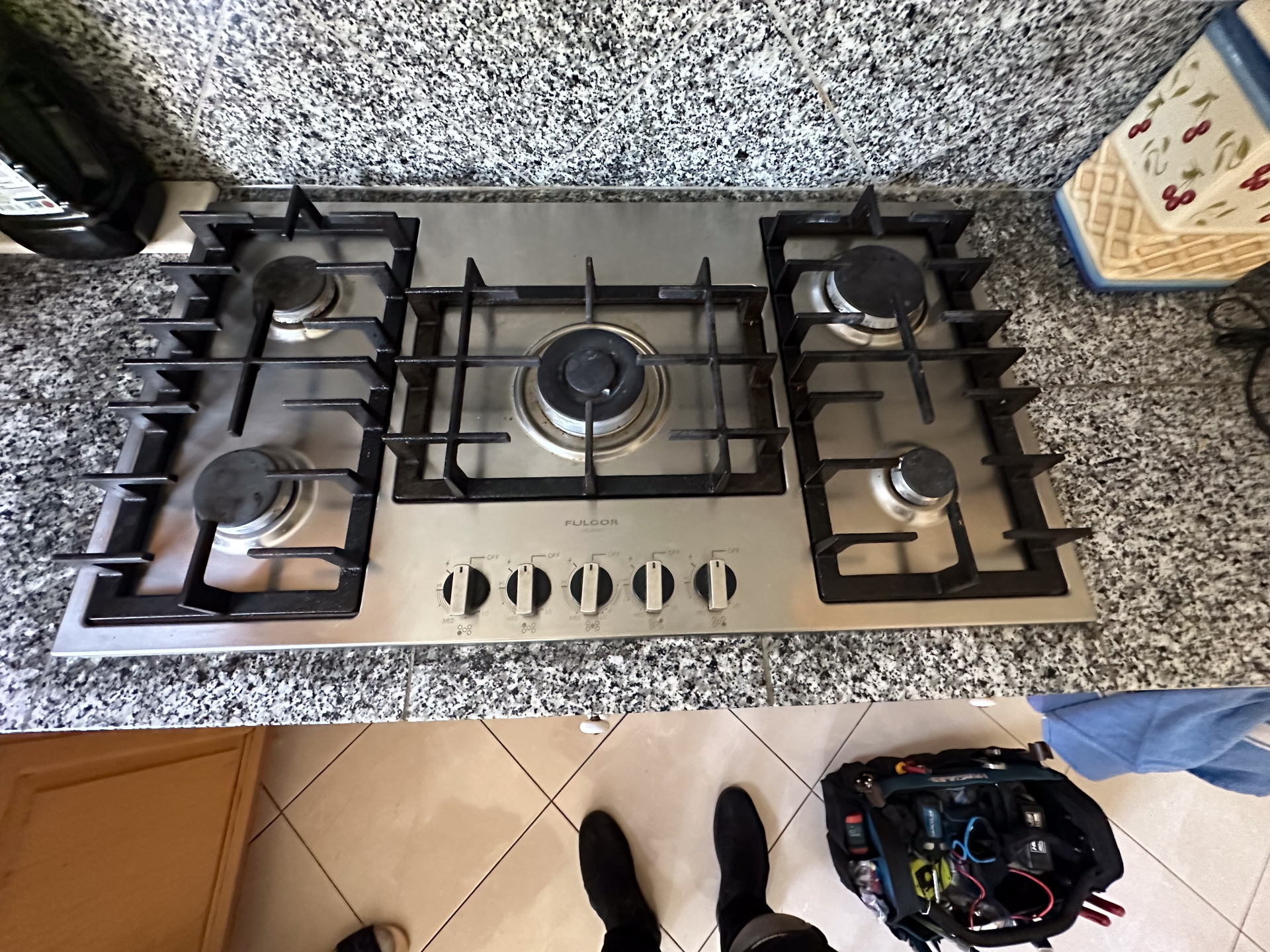
Table of Contents
- 1. Start Here: Gas or Electric?
- 2. Gas Ovens: It Is Almost Always the Igniter
- 3. Electric Ovens: It Is Almost Always the Bake Element
- 4. If the Oven Heats But Never Gets to Temperature
- 5. If It Died Right After a Self-Clean Cycle
- 6. What Each of These Repairs Costs
- 7. Four Things to Check Before You Call Anyone
- 8. Why Tri-Valley Kitchens Are Their Own Problem
- 9. Get It Fixed Before You Need It
- 10. Frequently Asked Questions
If your oven will not heat but the cooktop burners still work, the appliance is not dead and it is almost certainly not the wiring. Two parts account for the large majority of these calls, and which one it is depends entirely on what kind of oven you have.
Gas oven: the bake igniter. It weakens with age until it can no longer draw enough current to open the gas safety valve. You may see it glow and still get no flame.
Electric oven: the bake element. The loop at the bottom of the oven cavity burns through, usually with a visible blister or split.
One exception worth checking first. If your oven stopped working within a few days of running a self-clean cycle, skip ahead — that is a different failure with a different cause, and it is the single most common way a perfectly good oven dies.
Start Here: Gas or Electric?
Everything downstream depends on this, and most troubleshooting articles never ask.
Open the oven door and look at the bottom of the cavity. If you see a metal loop element, you have an electric oven. If you see a solid metal panel with no visible element, the burner is underneath it and you have a gas oven. If you are unsure, check whether there is a gas shutoff valve behind the range.
A note on the cooktop. People find it strange that the burners work while the oven does not, and read it as an electrical mystery. It is not. On a gas range the cooktop burners have their own igniters and their own gas path — they are essentially independent of the oven burner. On an electric range the surface elements run on separate circuits from the bake element. Working burners tell you the appliance has power. They tell you nothing at all about the oven.
The same logic explains a question we get constantly: the broiler works but the oven will not bake. The broil element is a separate part on a separate circuit, usually at the top of the cavity. If broiling works and baking does not, you have just confirmed the bake element or its circuit is the problem.
Gas Ovens: It Is Almost Always the Igniter
The bake igniter does two jobs. It gets hot enough to light the gas, and — this is the part people miss — it acts as the current sensor that tells the gas safety valve it is safe to open. The valve only opens when the igniter draws enough amperage.
Igniters degrade gradually. A worn one still glows, sometimes brightly, but no longer pulls enough current to trip the valve. So the symptom is a glow and no flame, or a long delay before ignition, or ignition on some cycles and not others.
What you can observe. Turn the oven to bake and watch through the door with the light on, or listen. A healthy gas oven glows, then you hear the gas catch within roughly 30 to 90 seconds. If it glows for two or three minutes with no flame, the igniter is failing. If nothing glows at all, the igniter has failed outright or has lost power.
Igniters are a wear part. On an oven that gets regular use, they are one of the most common appliance failures there is — and one of the least expensive to put right.
The other gas-side possibility is the safety valve itself, which is less common and costs more. A technician distinguishes them with a meter in a few minutes; there is no reliable way to tell by looking.
Electric Ovens: It Is Almost Always the Bake Element
The bake element is the loop at the bottom of the oven. It is a resistance heater, it runs hot every time you bake, and it eventually fails.
What you can observe. Let the oven cool completely, then look at the element closely along its whole length. A failed element usually shows a physical sign: a blister, a split, a section that has gone bright and scaled, or an obvious break. Sometimes you will find a scorch mark on the oven floor beneath the failure point.
You can also watch it during preheat. A working element glows evenly orange along its length. Dark patches, or a glow at one end only, mean it is on the way out.
If the element looks perfect and does not glow at all, the fault is upstream — the thermal fuse, the control board, or the relay that switches the element. Those are covered below.
If the Oven Heats But Never Gets to Temperature
This is a different problem and a different part. The oven works, it just runs cold, or stalls out.
You will recognize it in a few forms, all of which we hear regularly: the oven only ever reaches about 175 or 200 degrees, or it climbs to roughly 100 and stops, or it preheats but everything takes half again as long to cook and comes out pale.
Two likely causes:
The temperature sensor has drifted. A thin probe inside the cavity reports the temperature to the control board. As it ages its resistance drifts, so the board thinks the oven is hotter than it is and cuts the heat early. This is the most common cause of an oven that is accurate-ish but consistently low, and of an oven that used to bake fine and now does not.
The thermostat or control board is failing. Less common, more expensive, and the diagnosis requires measuring the sensor's resistance against the manufacturer's specification. If the sensor reads correctly and the oven still will not come up to temperature, the board is the suspect.
Before you assume either: an oven that is off by 25 degrees or so may just need recalibrating, which most ovens allow from the control panel. An oven that is 200 degrees low has a failed part.
If It Died Right After a Self-Clean Cycle
This is the one that catches people, and it deserves its own section because the cause is not obvious and the timing is so consistent.
The self-clean cycle is not a hot bake. Pyrolytic self-cleaning runs the oven to roughly 932°F (500°C) for about three hours in order to reduce food residue to ash. That is far hotter than any cooking temperature the appliance will otherwise see, sustained for far longer.
Most ovens survive it. But that heat is hard on components that are only specified for normal cooking temperatures, and several things commonly give way:
- The thermal fuse. This is a one-shot safety device that cuts power when the oven exceeds a set temperature. Self-clean pushes right up against its limit. When it trips, it does not reset — it has to be replaced, and until it is, the oven has no heat at all.
- Wiring insulation. The insulation on wiring near the cavity can degrade or melt with repeated high-heat exposure, causing intermittent faults or a dead circuit.
- The control board. Boards are built to tolerate heat, but excessive and repeated exposure can damage them.
- The door latch motor. The mechanism that locks the door during the cycle can fail from thermal stress, which can leave the door locked or leave the oven refusing to heat because it cannot confirm the latch position.
The practical advice: use self-clean sparingly, and never for the first time in months a week before you need the oven. If you are hosting, run it in early November or not at all. A wipe-down with a non-caustic cleaner carries none of this risk.
If your oven stopped heating within a few days of a self-clean, tell whoever you call. It narrows the diagnosis immediately and usually shortens the visit. Call us at (925) 667-3597 and lead with that detail.
What Each of These Repairs Costs
National figures put a typical oven repair at $150 to $350, with replacement running $700 to $1,600. Bay Area labor runs about 15 to 25 percent above the national average, for the reasons we laid out in our guide to what appliance repair costs in the Tri-Valley. Adjusting for that:
| Repair | National range | Tri-Valley estimate |
|---|---|---|
| Bake igniter (gas) | $150–$325 | $175–$405 |
| Bake element (electric) | $150–$450 | $175–$565 |
| Temperature sensor | $100–$250 | $115–$315 |
| Thermal fuse | $100–$250 | $115–$315 |
| Thermostat | $100–$350 | $115–$440 |
| Gas safety valve | $150–$400 | $175–$500 |
| Control board | $150–$600 | $175–$750 |
| Whole oven replacement | $700–$1,600 | $800–$2,000 |
Read that table next to the last row. An igniter or an element is a fraction of what a new range costs, which is why the overwhelming majority of no-heat ovens are worth repairing. The decision only gets interesting at the control board end of the range, on an older appliance, or when a pro-style range needs a part that is no longer stocked.
These are planning numbers, not quotes. The only honest quote comes after somebody meters the parts.
Four Things to Check Before You Call Anyone
Some of these calls do not need a technician, and we would rather tell you that than take the trip charge.
- Check that the oven is not in a mode. Delay start, Sabbath mode, demo mode and an active control lock will all leave an oven that appears powered and refuses to heat. Look for an unfamiliar icon on the display. Cutting power at the breaker for a minute clears most of them.
- Cut power and restore it. Thirty seconds at the breaker resets a hung control board. This genuinely fixes a real share of no-heat complaints and costs you nothing.
- Look at the bake element, if you have one. Cool oven, door open, inspect the full loop for a blister, split or break. If you find one, you have your answer and you can tell us the part before we arrive.
- Check that the oven door closes and latches fully. Many ovens will not begin a heating cycle if the latch does not report closed. A warped hinge or a gasket that has come loose from its channel is a cheap fix that presents as a dead oven.
Where to stop. Anything involving the gas supply, the safety valve or the burner assembly is licensed work — not because the part is complicated, but because getting it wrong leaks gas. The same goes for the 240-volt circuit behind an electric range. Replacing a bake element is within reach for a confident homeowner with the breaker off and the correct part; replacing an igniter, a safety valve or a control board is not a job to learn on.
Why Tri-Valley Kitchens Are Their Own Problem
Two things make oven repair in this area different from the national picture, and both come down to timing.
Pro-style ranges are everywhere here. Danville, Blackhawk, Alamo and the Pleasanton hills have an unusual concentration of Viking, Wolf, Thermador, Miele and Sub-Zero kitchens. Those are excellent appliances and they are very repairable — but their parts are brand-specific and frequently not sitting on anybody's truck. A Whirlpool bake element is a stocked item. A Thermador control board can mean ordering, and ordering means a second visit. If you have a pro-style range, the calendar matters more than the diagnosis. We handle these across appliance repair in Danville and the rest of the valley, but we will tell you honestly when a part has to come from the distributor.
And then there is the holiday math. Thanksgiving falls on Thursday, November 26 this year. Every appliance repair company in the East Bay has the same November: the calls arrive in the last ten days of the month, all at once, from people who discovered the problem while preheating. If your oven is behaving strangely now — slow to preheat, uneven browning, a longer glow than it used to have before the gas catches — that is the appliance giving you eight weeks of warning. Used in October, that warning is a routine service call with parts in stock. Ignored until the week of the holiday, it is an emergency with a lead time.
We would rather see you in October.
Get It Fixed Before You Need It
If your oven is not heating, is not holding temperature, or has started taking noticeably longer to preheat, it is worth a look now rather than in November.
Dr. Appliance has been repairing ovens, ranges and cooktops in Livermore for over 20 years. We are family-owned, licensed and insured, and we stock common parts — igniters, elements, sensors, fuses — on our service vehicles so most jobs finish on the first visit. We serve Livermore, Pleasanton, Dublin, San Ramon, Danville, Tracy, Fremont, Walnut Creek, Lafayette, Alamo, Blackhawk, Moraga, Orinda, Sunol, Pleasant Hill and Castro Valley, and same-day and next-day appointments are usually available.
We handle oven, stove and range repair for gas and electric, freestanding and built-in, including pro-style ranges. We also cover refrigerator and freezer repair, washer and dryer repair, dishwasher repair and microwave repair — you can browse all of our services, or see the rest of what we do across appliance repair in Livermore.
Call (925) 667-3597 and tell us three things: gas or electric, what the oven is doing, and whether you have run a self-clean cycle recently. That is usually enough for us to arrive with the part. You can also reach us through our Contact us page.
Sources: self-clean cycle temperature and duration from Wikipedia's article on self-cleaning ovens; the self-clean component failure modes from Dependable Services; repair and replacement cost figures from HomeGuide's 2026 oven repair cost guide, corroborated by Angi.
Frequently Asked Questions
Ready to Schedule a Repair?
Dr. Appliance provides fast, professional appliance repair for homes and businesses throughout Livermore and the Tri-Valley.